
Peptide storage: the temperature guide for research-grade reference standards.
How to store lyophilized peptide reference standards correctly: −20°C vs −80°C vs refrigerated. Shelf life and freezer recommendations…
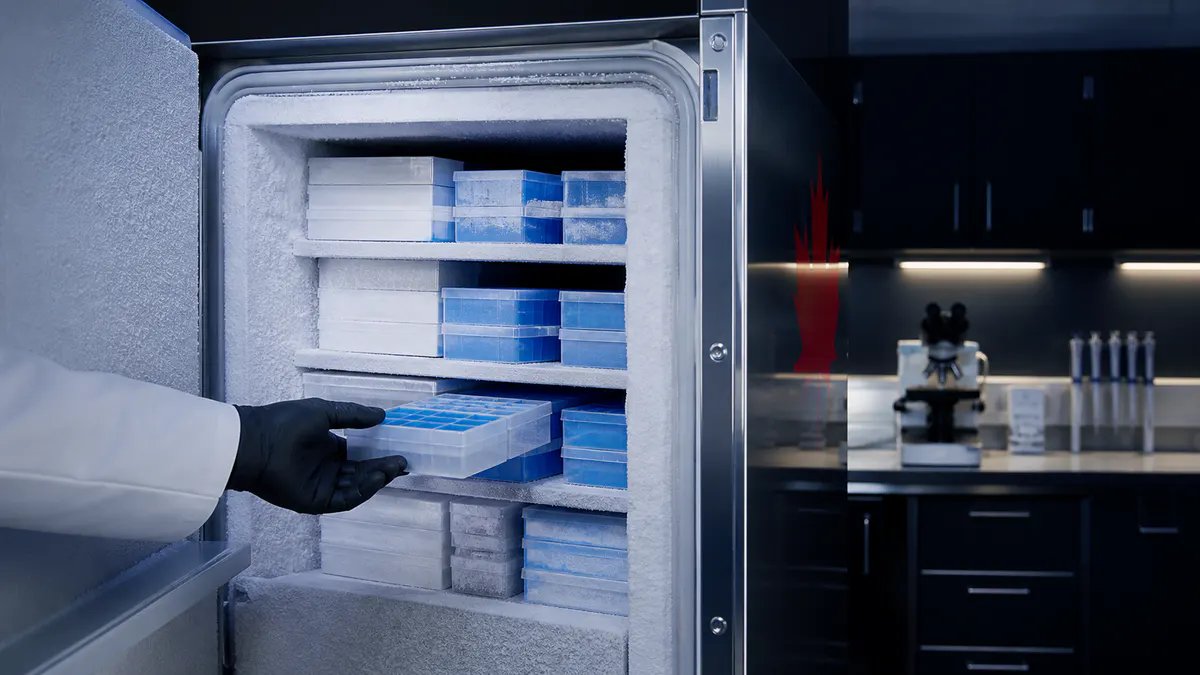
Storage temperature is the single biggest determinant of peptide reference-standard shelf life. This guide covers lyophilized storage, post-reconstitution stability, freeze-thaw handling, and what to do if you receive a shipment that arrived warmer than it should have.
A lyophilized peptide, sealed under nitrogen, stored at −20 °C in the dark, is stable for years. The same peptide, reconstituted, kept at room temperature in plain saline, is measurably degraded within weeks. The difference between those two endpoints isn't the molecule, it's the storage protocol. Researchers who care about reproducibility care about storage protocols.
Lyophilized, sealed: the canonical storage state
All Pure North Peptides reference standards ship lyophilized (freeze-dried) and sealed under inert gas. In that state, the peptide is in a glassy, water-free solid with negligible molecular mobility. Hydrolysis, the dominant degradation pathway for peptides in solution, is functionally arrested in the dry state.
- Select storage conditions using validated material-specific stability information. The published CPT reports are analytical snapshots, not storage-stability studies.
- −80 °C, deeper stability margin for multi-year research programs or for compounds known to be especially sensitive (e.g., IGF-1 LR3, where degradation kinetics in solution are notably faster than the average peptide). Not required for retention shorter than ~2 years.
- 2-8 °C (refrigerator), acceptable for short-term storage (weeks to ~2 months) if a freezer is unavailable, but not appropriate for lots you intend to keep. Cycling between fridge and bench heats and cools the vial repeatedly, minor on its own, accumulates over many access events.
- Ambient (room temperature), do not use for storage. Even sealed and dry, lyophilized peptides degrade meaningfully at 20-25 °C over weeks. Anything left on the bench overnight should be returned to the freezer the next morning; anything left for days should be retested before research use.
Freezer choice matters
Any research-grade −20 °C chest or upright freezer with temperature logging is sufficient. Two operational notes:
- Avoid frost-free units. Frost-free (auto-defrost) freezers periodically warm a small region of the chamber to evaporate ice buildup. These thaw cycles introduce temperature excursions that, over hundreds of cycles, accelerate degradation. A manual-defrost unit holds set-point more reliably.
- Use a data logger. A single-probe USB or wireless temperature logger inside the freezer creates an audit trail. If a researcher ever questions a lot's history, the chart speaks for itself. This is especially important for academic labs where the freezer is shared.
- Position vials away from the door. Front-shelf vials see the biggest temperature excursions during every door-open event. Long-retention lots should sit deep in the chamber.
After reconstitution: the working solution timeline
Once a peptide is reconstituted in bacteriostatic water or buffer, the lyophilized-stability clock stops and the in-solution clock starts. General guidance:
- 4 °C, refrigerated, dark: the standard storage state for working solutions. Most peptides are stable in solution for ~28 days under these conditions; some shorter or more lysine-rich sequences (e.g., TB-500 active fragment, hexarelin) are best used within 14-21 days.
- Freeze-thaw cycles degrade activity. If you anticipate more than ~3 access events, aliquot the working solution into single-use volumes before freezing. Each freeze-thaw introduces local concentration gradients during ice formation that stress the peptide.
- Avoid plain water. Peptide reconstitution in pure ASTM-grade water is acceptable for an immediate-use experiment, but solutions stored more than a day should be in bacteriostatic water (0.9% benzyl alcohol) or an appropriate buffer.
Receiving a shipment in Canada
Pure North Peptides is Canadian-based and ships via Canada Post Xpresspost, orders are dispatched within 24-48 hours, with typical transit around 4 days coast to coast. Shipments include a cold pack to slow ambient warming during transit. On arrival:
- Move vials to −20 °C within minutes of unboxing. The cold pack buys roughly 24-36 hours of cool ambient; not a justification for delay.
- Check the gel pack state. Fully thawed and warm (above ~20 °C in summer) on arrival is the signal to contact support, cold-chain failure is reviewed case-by-case per the returns policy.
- Inspect for vial integrity. Cracks, broken seals, or any sign that the vial cap moved during transit warrants a damage-on-receipt report. Document with photo before returning to the freezer.
- Record the lot number and arrival date in your inventory log. This is the audit trail you'll want if a downstream reviewer asks about lot history.
Cold-chain in Canadian summer + winter
Domestic Canadian shipping in summer (peak ambient 30+ °C in BC interior and parts of Ontario) is the more demanding case. Pure North Peptides uses ice packs sized for the transit window plus an insulated cardboard liner. Winter is the easier case, ambient temperatures across most of Canada are at or below refrigeration range for ~5 months a year. The one winter gotcha: protect vials from freezing-mailbox conditions. A vial outside in −30 °C overnight is fine, but if your shipment sits in a mailbox cycle from −30 to indoor 22 °C and back, that's a freeze-thaw the lot didn't need.
FAQ
Is a regular kitchen freezer sufficient?
For short-term storage (weeks to a few months), yes, if it's manual-defrost and holds set-point reliably. For multi-year retention you want a dedicated lab freezer with temperature logging. Most kitchen freezers cycle through warmer phases that aren't ideal.
What happens if my lot sat at room temperature for a few days?
Lyophilized peptide sealed under nitrogen tolerates short ambient excursions well, days, not weeks. Move to −20 °C and resume normal storage. If the lot sat for more than ~7 days at warm ambient or shows any sign of moisture intrusion (e.g., the powder caking), consider it suspect and contact support.
How long is a reconstituted peptide stable at 4 °C?
Sequence-dependent but ~28 days is a reasonable default for most lyophilized peptides reconstituted in bacteriostatic water. Shorter sequences, methionine-containing peptides, and free thiol-containing peptides degrade faster. Aliquot and freeze if you need longer.
Does the COA stability claim apply once I open the vial?
No. The published CPT reports do not establish storage or in-solution stability. Use a validated material-specific handling protocol.
Can I refreeze a reconstituted working solution?
Yes, but each freeze-thaw cycle costs measurable activity. Aliquot before freezing so each thaw is a single-use volume.
For laboratory research use only. Reference information, not medical advice or human-use guidance.
