
Bacteriostatic water vs sterile water for peptide reconstitution
Bacteriostatic water (0.9% benzyl alcohol) preserves reconstituted peptide for 28 days; sterile water is single-use only. The chemistry, the trade-off, and…
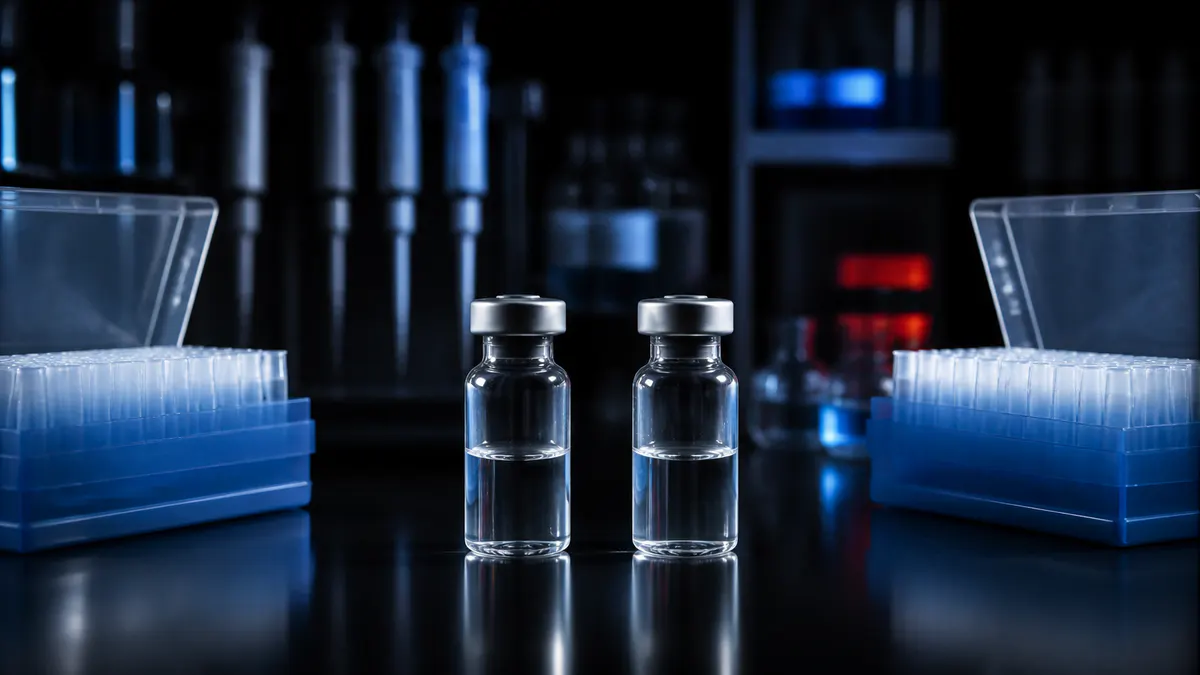
Short answer. Bacteriostatic water contains 0.9% benzyl alcohol, which inhibits microbial growth and lets a reconstituted peptide vial be used over a 28-day window. Sterile water has no preservative, once the peptide is reconstituted with sterile water, the vial is single-use and must be discarded after the first draw or within 24 hours.
What benzyl alcohol does
0.9% benzyl alcohol is a long-validated bacteriostatic agent: it inhibits bacterial proliferation in the vial while remaining inert to most peptide structures at the concentrations used. The "bacteriostatic" label means it stops growth; it doesn't kill organisms outright, so cleanly drawn aliquots from a previously punctured vial remain usable for the labeled storage window (typically 28 days at 2-8 °C).
When to use sterile water instead
- Single-use experiments: if you'll consume the entire reconstituted vial in one work session, sterile water is fine.
- Benzyl-alcohol-sensitive assays: some receptor-binding assays show concentration-dependent benzyl-alcohol artifacts at high peptide-stock concentrations. Switch to sterile water for sensitive screens; quench the vial after one draw.
- Specific cell lines: a few cell lines show benzyl-alcohol toxicity at typical peptide working concentrations. Verify with a vehicle control.
Multi-day workflow
For most peptide research, bacteriostatic water is the right choice, the 28-day reuse window matters when you're aliquoting weekly or running time-course studies. Pure North supplies bacteriostatic water as a 10 mL multi-dose vial.
Storage after reconstitution
- Bac water-reconstituted: 2-8 °C, 28 days, original vial. For longer storage, aliquot to low-binding tubes and freeze at −80 °C.
- Sterile-water-reconstituted: single-use only, or aliquot immediately and freeze at −80 °C.
- Either way: visually inspect the solution before each draw, turbidity, color shift, or particulates means discard the vial.
Frequently asked questions
Does benzyl alcohol affect peptide stability?
At 0.9% in bac water, benzyl alcohol is generally inert toward standard research peptides. A few cell lines or sensitive assays show artifacts; verify with a vehicle control if uncertain.
How long does reconstituted peptide last in bac water?
Typically 28 days at 2-8 °C in the original vial. Longer storage as −80 °C aliquots.
Can I use saline instead?
0.9% saline lacks the bacteriostatic preservative and changes the ionic strength of the solution, not equivalent to either bac water or sterile water for typical peptide work.
Where to buy bacteriostatic water in Canada?
Pure North Peptides supplies it at /products/bac-water/ as a 10 mL multi-dose vial.
What if my peptide is benzyl-alcohol-sensitive?
Use sterile water and treat the vial as single-use, or reconstitute and immediately aliquot/freeze at −80 °C in single-use tubes.
Disclaimer: All Pure North Peptides products are supplied for laboratory research use only. They are not approved by Health Canada as drugs. See our research-use declaration for full terms.
For laboratory research use only. Reference information, not medical advice or human-use guidance.
