
Lyophilization 101 for research peptides
How peptides are lyophilized, why it matters for shelf life, and what to look for in the cake's appearance to spot a flawed cycle.
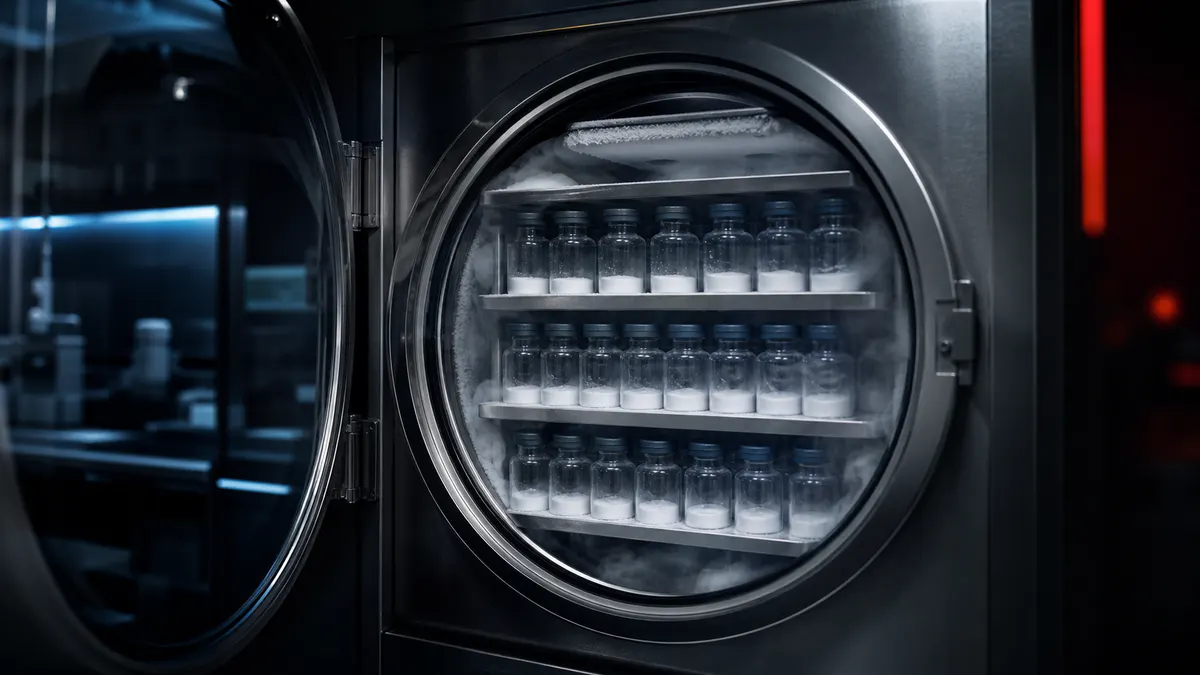
Short answer. Lyophilization (freeze-drying) removes water from a frozen peptide solution by sublimation under vacuum. Done correctly, it produces a uniform white cake that retains peptide structure for 24+ months. Done badly, the cake collapses, retains too much water, or partially melts during the cycle, all visible by inspection.
The three-stage cycle
- Freezing: the peptide solution is rapidly frozen, typically with controlled-rate freezing to a shelf temperature of −40 to −50 °C. Slow freezing creates large ice crystals that damage peptide structure; controlled rapid freezing produces fine crystals that sublime cleanly.
- Primary drying: chamber vacuum drops to 50-200 mTorr; shelf temperature ramps gradually to drive ice sublimation. Removes ~95% of the water. Takes ~4 days for typical peptide formulations.
- Secondary drying: shelf temperature ramps higher (5-25 °C) to remove bound water. Reduces residual moisture from ~5% down to < 2%. Takes 6-12 hours.
Cake quality inspection
Before reconstituting, inspect the cake against a dark background:
- Good cake: uniform white or off-white, fills the bottom of the vial cleanly, holds its shape, no visible pull-back from the glass.
- Collapsed cake: appears melted or compressed, often with a glassy or shiny surface. Caused by primary-drying temperature exceeding the formulation's collapse temperature. Usually still functional but reduced shelf life.
- Cracked cake: visible fissures or gaps. Cosmetic; doesn't affect peptide quality.
- Pulled-away cake: the cake has separated from the glass walls, leaving a gap. Indicates excess shrinkage during secondary drying. Reconstitution behavior usually fine.
- Yellow or off-color cake: oxidation marker. The peptide may have degraded during cycle. Reject.
Why this matters for research
Pure North publishes laboratory reports for the samples and vial sizes listed in Lab Results. Each report identifies its method, reference, area purity and measured content. Open the matching product page to check coverage for the size you select. A report does not cover every size or future lot; contact customer service if your vial reference differs. Bacteriostatic water has no COA.
Storage of lyophilized peptide
Sealed under nitrogen, desiccated. Avoid temperature cycling, repeated thaws around the freezer's set-point compromise the dried form. For peptides with surface-active or hydrophilic residues, vacuum-stoppered vials prevent atmospheric moisture from rehydrating the cake during storage. Once you are ready to bring a vial into solution, see our reconstitution reference for the bench procedure.
Frequently asked questions
Can a partially collapsed cake still be used?
Usually yes for in-vitro work, the peptide is intact, just compressed. Verify with HPLC retention against a reference run if precision matters.
Why is moisture < 2% the target?
Higher residual moisture accelerates degradation reactions during long-term storage (deamidation, oxidation, hydrolysis). The 2% bar gives 24+ month shelf life on stable peptides.
How is residual moisture measured?
Karl Fischer titration. Reference-grade COAs report Karl Fischer values; absence on a COA is a red flag.
Should I reject a yellow cake?
Yes. Yellow color indicates oxidation; the peptide structure is likely compromised. Contact the supplier.
Why nitrogen flush?
Replaces atmospheric oxygen in the headspace, preventing oxidation of methionine, cysteine, and tryptophan residues during long-term storage.
Disclaimer: All Pure North Peptides products are supplied for laboratory research use only. They are not approved by Health Canada as drugs. See our research-use declaration for full terms.
For laboratory research use only. Reference information, not medical advice or human-use guidance.