
Thymosin alpha-1 vs beta-4: two confused peptides
They share a name and an origin tissue and almost nothing else. One is an immune signalling peptide, the other an actin-binding repair peptide.
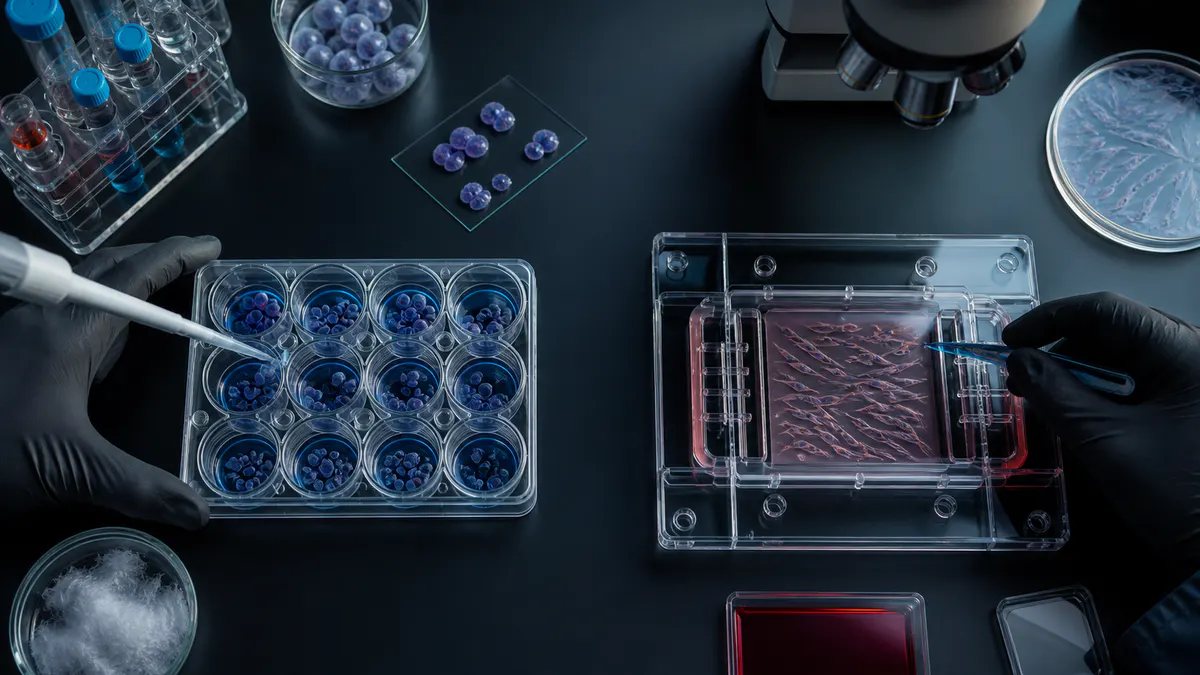
The shared "thymosin" label causes more confusion than any other naming collision in peptide research. The two are not variants of one molecule. They were isolated from the same tissue fraction and named accordingly; the biology diverges completely.
| Thymosin alpha-1 | Thymosin beta-4 (TB-500) | |
|---|---|---|
| Length | 28 residues | 43 residues (full length) |
| Molecular weight | 3018.37 g/mol | 4963.44 g/mol (acetate) |
| Primary mechanism | TLR2 / TLR9 signalling | G-actin sequestration |
| Research axis | Immune modulation | Cell migration / tissue repair |
| N-terminus | Acetylated | Acetylated |
Alpha-1 is an immune signalling peptide
Thymosin alpha-1 participates in T-lymphocyte maturation. Published work describes signalling through Toll-like receptors — principally TLR2 and TLR9 — on dendritic cells and monocytes, with MyD88-dependent activation driving downstream cytokine programmes and Th1-skewed differentiation. The relevant assays are TLR activation panels, dendritic-cell maturation markers and cytokine polarisation.
Beta-4 is a cytoskeletal protein
Thymosin beta-4 binds and sequesters monomeric G-actin, holding a reserve pool that buffers filament assembly and lets cells remodel their cytoskeleton quickly. That actin-binding activity is what links it to cell migration, endothelial tube formation and wound closure. The relevant assays are actin-polymerisation kinetics and migration assays — nothing immunological.
Why it matters practically
If a protocol says "thymosin" without a Greek letter, it is ambiguous and you should not proceed on assumption. The two produce unrelated readouts, and a lab that orders one expecting the other loses the experiment, not just the vial. Check the molecular weight on the certificate: 3018 and 4963 g/mol are not close.
Selected literature
- Romani L et al. Thymosin alpha1 activates dendritic cell tryptophan catabolism. Blood. 2006;108(7):2265-2274.
- Goldstein AL et al. Thymosin beta4: actin-sequestering protein moonlights to repair injured tissues. Trends Mol Med. 2005;11(9):421-429.
Both stocked, each with a lot-specific COA: Thymosin Alpha-1 10 mg · TB-500 10 mg. For laboratory research use only.
For laboratory research use only. Reference information, not medical advice or human-use guidance.

