
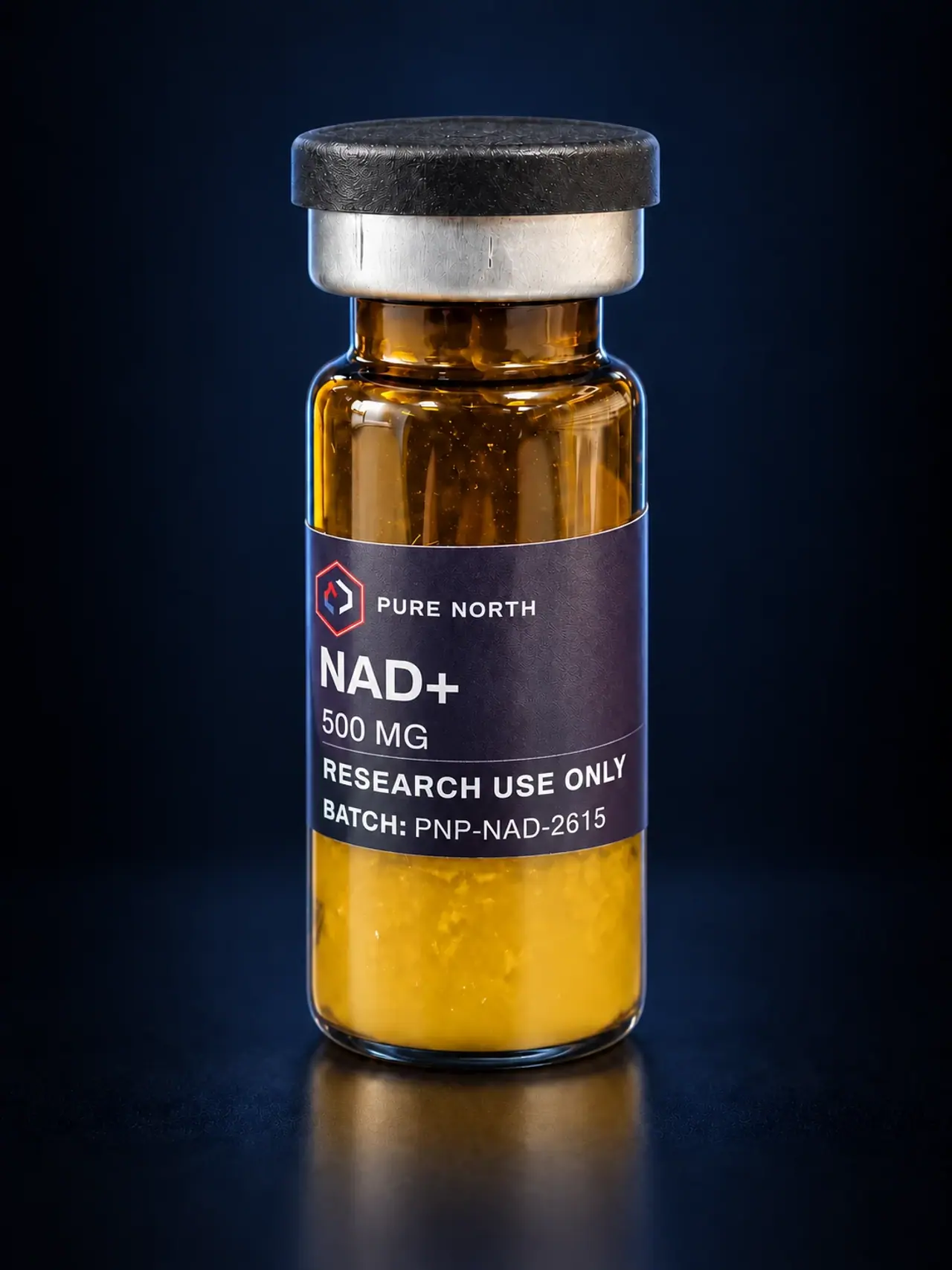

NAD+
500 mg
$45 CAD$0.09/mg
View sample COA · 500 mg
99.27% area purity · 483.50 mg measured content
Lot: PNP-NAD-2615 · Report CPT-NAD-500-091226
In stock500 mg per vial
1
How payment works: submit your order, then follow the Interac e-Transfer or Bitcoin instructions shown on the confirmation screen. Orders ship after payment is confirmed. Shipping is $30 CAD, free once your subtotal reaches $300 before any discount.
$45 CAD
Longevity - Coenzyme →
Nicotinamide adenine dinucleotide for cellular-energy and longevity research. Lyophilized, HPLC-verified.
Independent lab result
Canada Peptide Testing ↗NAD+ · 500 mg vial
Lot: PNP-NAD-2615
Purity
99.27%
Measured
483.5 mg
Label claim
500 mg
Fill accuracy
96.7%under label
Method
RP-HPLC-UV, 214 nm
Specification
≥ 98.0% area purity
Tested
2026-09-09
Reported
2026-09-12
Report CPT-NAD-500-091226. Results apply to the sample tested. Purity is area purity by RP-HPLC-UV, 214 nm; these certificates carry no endotoxin or mass-spectrometry result. All certificates →
For laboratory research use only. Handling & research protocol →
Free shipping over $300, flat $30 underDispatched in 24–48h by Canada Post XpresspostTracked on dispatch, discreet outer packagingBest price in Canada — found it cheaper? we'll match it →
NAD+ on PubMed
Independent published literature indexed on PubMed (U.S. National Library of Medicine). Provided for laboratory research reference only.
- PMID 26785480NAD⁺ in aging, metabolism, and neurodegenerationScience · 2015 · PubMed →
- PMID 33353981NAD(+) metabolism and its roles in cellular processes during ageingNat Rev Mol Cell Biol · 2021 · PubMed →
- PMID 37424179NAD metabolism: Role in senescence regulation and agingAging Cell · 2024 · PubMed →
NAD+ questions
What certificate is published for NAD+?
Yes. The independent certificate for the 500 mg vial, report CPT-NAD-500-091226, is published on this page and in Lab Results. It covers the sample and size named on the report. For another size or lot, contact purenorthpeptides@proton.me.
How is NAD+ shipped?
Orders ship from Canada by Canada Post Xpresspost. Delivery is usually about four days, with free shipping once the pre-discount subtotal reaches $300 CAD.
How do I pay?
Submit the order online, then follow the Interac e-Transfer or Bitcoin instructions on the confirmation screen. No card details are entered anywhere on the site.
Where is the reported NAD+ dosage and reconstitution information?
The NAD+ protocol page reproduces the schedule, route and cycle length reported in published research, and computes a reconstitution concentration table for the 500 mg vial we ship. It is reference information for laboratory research, not a recommendation. The peptide calculator does the syringe-unit arithmetic for any solvent volume.
No reviews for NAD+ yet. Reviews here can only be written by someone who bought the product, using a single-use link emailed after the order ships, and each one is approved by a person before it appears. Only genuine, approved buyer feedback appears here.
How reviews work here →Products from the same research category, plus compatible laboratory diluent where applicable.


