
Peptide solubility troubleshooting: when your vial won't dissolve
Insoluble peptide vials usually trace to one of four causes. A diagnostic walk-through for sequence-driven solubility failures and how to recover stuck…
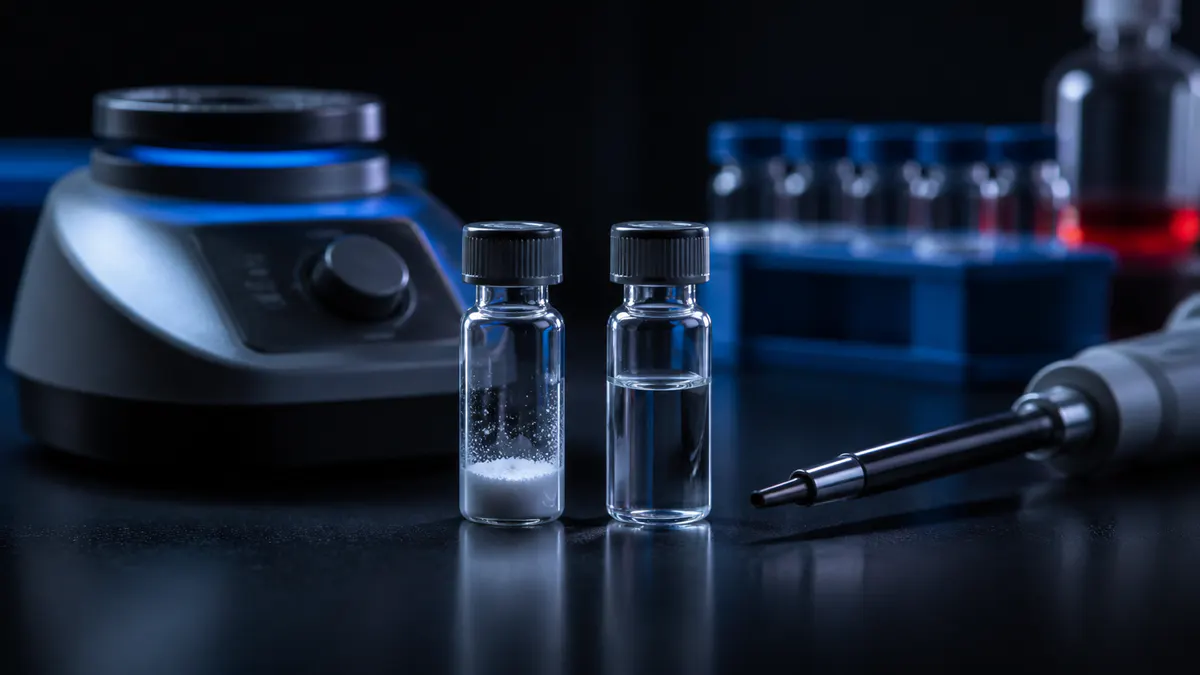
Short answer. A peptide that won't fully dissolve in bacteriostatic water at neutral pH usually has one of four problems: hydrophobic sequence (non-polar residues > 50%), pI matching the buffer pH (charge-neutral aggregation), aggregated lyophilization (the cake is too dense to wet-out), or a counter-ion mismatch from the cleavage chemistry.
Decision tree
1. Hydrophobic sequence
Peptides with high non-polar residue content (Val, Ile, Leu, Phe, Trp) often need a co-solvent for initial dissolution. Add 5-10% DMSO to the bacteriostatic water; dissolve at 5-10 mg/mL; dilute back into your assay buffer at the working concentration. Keeps the DMSO concentration in the final assay below 0.1% which most cell lines tolerate.
2. Charge-neutrality (pI matching)
Peptides with isoelectric point near physiological pH (6.5-7.5) aggregate at neutral pH because of charge neutrality. Slightly acidify (1% acetic acid in bac water, pH ~4) for initial dissolution; back-titrate to neutral with dilute NaOH if your assay needs neutral pH.
3. Aggregated lyophilization
Sometimes the lyophilized cake is too dense to wet-out from the top. Solution: invert the vial, hold horizontal, and inject the bac water slowly down the inner wall, let it pool against the cake from the side, not from above. Swirl gently; allow 5 minutes; do not vortex.
4. Counter-ion mismatch
Synthetic peptides come with a counter-ion (usually acetate or trifluoroacetate from cleavage). High residual TFA can cause unexpected solubility behavior, peptides that should be soluble at neutral pH may need acidification first to dissolve, then back-neutralization. Check the COA for residual TFA < 1.0%; higher values may need acid-base cycling for clean dissolution.
What NOT to do
- Don't sonicate: sonication denatures secondary structure and can fragment longer chains.
- Don't heat above 37 °C: peptides degrade thermally; warm-water dissolution should top out at body temperature.
- Don't vortex: shear forces fragment longer peptides and create surfactant-like foaming that traps air.
- Don't repeatedly freeze-thaw: if a vial is stuck, work it once with one of the strategies above; if still stuck, contact the supplier rather than repeated cycling.
Frequently asked questions
Can I use ethanol to dissolve a stuck peptide?
Yes for short-term solubilization at low percentage (< 5% in the final assay buffer). Watch for ethanol-sensitive cell lines and verify with a vehicle control.
How much DMSO is too much?
Most cell lines tolerate 0.1% DMSO without artifacts. Above 0.5% DMSO becomes a confound; redesign the assay with a lower stock concentration before going higher.
My peptide is cloudy after reconstitution, bad lot?
Not necessarily. Cloudiness can indicate aggregation rather than impurity. Try acid pre-dissolution then back-titration; if still cloudy after a clean strategy, contact the supplier with the lot number.
Should I filter the reconstituted solution?
0.22 μm filter is fine for bacteriostatic-quality work. Use low-binding filters; some peptides adsorb significantly to standard cellulose-acetate filters.
How do I know it's fully dissolved?
Visually clear at 1 mg/mL or higher, no particulates against a dark background. UV-Vis at 280 nm should match the expected extinction coefficient if the peptide contains aromatic residues.
Related reading: once a vial dissolves cleanly, protect the working solution with sound handling, see the storage temperature guide and notes on freeze-thaw stability.
Disclaimer: All Pure North Peptides products are supplied for laboratory research use only. They are not approved by Health Canada as drugs. See our research-use declaration for full terms.
For laboratory research use only. Reference information, not medical advice or human-use guidance.