
How to read a peptide certificate of analysis
Start with the original report. Check which sample it describes, distinguish area purity from measured content, and read the limits before applying a result to your vial.
A worked example from our published BPC-157 report
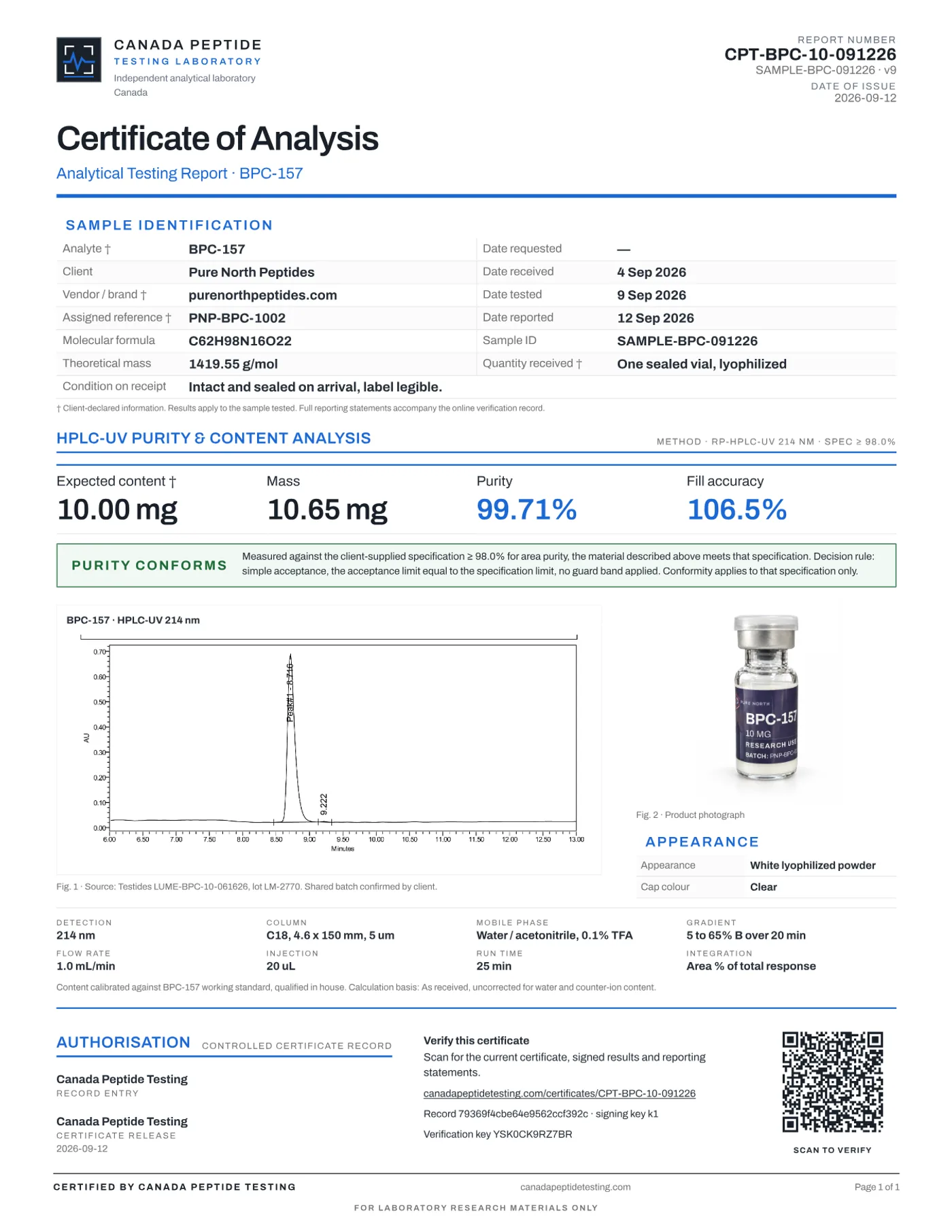
Report CPT-BPC-10-091226 covers a 10 mg vial. It reports 99.71% RP-HPLC-UV area purity and 10.65 mg measured content against a 10 mg label claim. The document records Assigned reference: PNP-BPC-1002. These are different fields, not interchangeable quality scores.
The sample was received 2026-09-04, tested 2026-09-09 and reported 2026-09-12. Figure 1 credits Testides LUME-BPC-10-061626, lot LM-2770, with the disclosure “Shared batch confirmed by client.” Preserve that disclosure when reading the trace; do not describe it as a newly generated chromatogram of every supplied vial. The original PDF and laboratory verification record are linked above.
HPLC area purity is not the percentage of the vial filled with peptide
HPLC separates components under a particular method. The UV detector produces a chromatogram, and area purity expresses the target peak's share of the integrated detector response. Results depend on the method, wavelength, separation and integration. Components do not necessarily have equal detector responses, and some material may not be detected by that method.
A high area-purity percentage does not tell you the total peptide mass in a vial. It also does not establish sterility, endotoxin status or mass-spectrometry identity. Read measured content separately, and do not treat the remaining area percentage as a complete inventory of everything else in the vial.
Measured content answers a different question
In this example, 10.65 mg is the reported content result, compared with the 10 mg label claim. It is not calculated by multiplying 10 mg by 99.71%. The report uses an in-house-qualified working standard and an as-received calculation, uncorrected for water and counter-ion content. Keep those qualifications when comparing results.
Compare both results. A sample can have high area purity and still measure below its label claim. Our lab-results table publishes measured content alongside area purity, including results below label claim.
Scroll the table sideways to see all columns.
| Named sample | Area purity | Measured / label | Fill accuracy |
|---|---|---|---|
| BPC-157 10 mg vial | 99.71% | 10.65 mg / 10 mg | 106.5% |
| GHK-Cu 50 mg vial | 99.84% | 40.80 mg / 50 mg | 81.6% |
Read the test panel one measurement at a time
A certificate should state which measurement was performed. A missing test is not a passing result. Use the method and its stated limitations to decide whether the evidence answers your research question.
Scroll the table sideways to see all columns.
| Measurement | What to read | Published CPT set |
|---|---|---|
| HPLC-UV area purity | The target peak's share of integrated detector response under the stated method. | Reported; read the wavelength and integration basis. |
| Measured content | The separate mass result, its calibration standard and calculation basis. | Reported in milligrams. |
| Fill accuracy | Measured content compared with the label claim. | Reported as a percentage of label. |
| Mass-spectrometry identity | A separate identity measurement; area purity does not replace it. | Not included. |
| Endotoxin | A separate test; a high HPLC percentage is not an endotoxin result. | Not included. |
| Sterility | A separate microbiological question; chromatographic purity does not establish it. | Not established by these reports. |
Match the report to the material
Match the compound, vial size and printed lot to the report before relying on it. An assigned reference is not automatically the batch code on a vial. If they differ, email purenorthpeptides@proton.me with the vial details and report number to confirm the connection. Do not extend a report to another size or lot.
Record the report number, issuer, test dates and sample description. Follow the verification link to the laboratory's record. A report authenticating one submitted sample does not establish a complete chain of custody for every vial sold under the same product name.
Who performed the testing, and what is not included
Pure North commissioned Canada Peptide Testing, as a paying client, and publishes 13 independent reports at /lab-results/. Each report covers only its named sample, vial size and lot or assigned reference. Manufacturer QC documents may be available on request for other peptide lots; they are not independent reports. Selank, Semax and Tirzepatide COAs are temporarily unavailable. Bacteriostatic water has no COA.
The published Canada Peptide Testing reports measure RP-HPLC-UV area purity and content. They do not include mass-spectrometry identity, endotoxin, water content or a related-substances breakdown. These results do not establish clinical safety or regulatory approval.
An outside laboratory can be independent of the seller and still be paid by that seller. Disclosing that relationship is more useful than implying the lab had no commercial relationship. Manufacturer QC is a separate source of evidence and should be labelled as such.
Before ordering in Canada
Choose the compound and vial size first, then check the documentation for that exact presentation. For the ordering and delivery steps, see /canada-peptides/. For a supplier-document checklist, see /library/how-to-choose-a-peptide-supplier-canada/. For laboratory research use only.
Frequently asked
- Does 99% HPLC purity mean a 10 mg vial contains 9.9 mg?
- No. Area purity describes chromatographic detector response. Measured content is a separate assay result; it cannot be inferred by multiplying the label claim by the area-purity percentage.
- Are Pure North's published reports independent?
- Pure North commissioned Canada Peptide Testing, as a paying client, and publishes 13 independent reports at /lab-results/. Each report covers only its named sample, vial size and lot or assigned reference. Manufacturer QC documents may be available on request for other peptide lots; they are not independent reports. Selank, Semax and Tirzepatide COAs are temporarily unavailable. Bacteriostatic water has no COA.
- Do these reports include mass spectrometry or endotoxin testing?
- The published Canada Peptide Testing reports measure RP-HPLC-UV area purity and content. They do not include mass-spectrometry identity, endotoxin, water content or a related-substances breakdown. These results do not establish clinical safety or regulatory approval.
- What if the assigned reference differs from my vial's batch code?
- Match the compound, vial size and printed lot to the report before relying on it. An assigned reference is not automatically the batch code on a vial. If they differ, email purenorthpeptides@proton.me with the vial details and report number to confirm the connection. Do not extend a report to another size or lot.
- Where can I read the original report?
- Open Lab Results, find the matching compound and vial size, and use the original PDF and laboratory verification links. A report for a different size or lot should not be used as evidence for yours.
Referenced in our catalog
Read the published report for the named sample and size. Contact customer service if you need help matching an assigned reference or confirming documentation for another lot. Published reports and coverage
For laboratory research use only. Reference information, not usage guidance or dosing advice.