
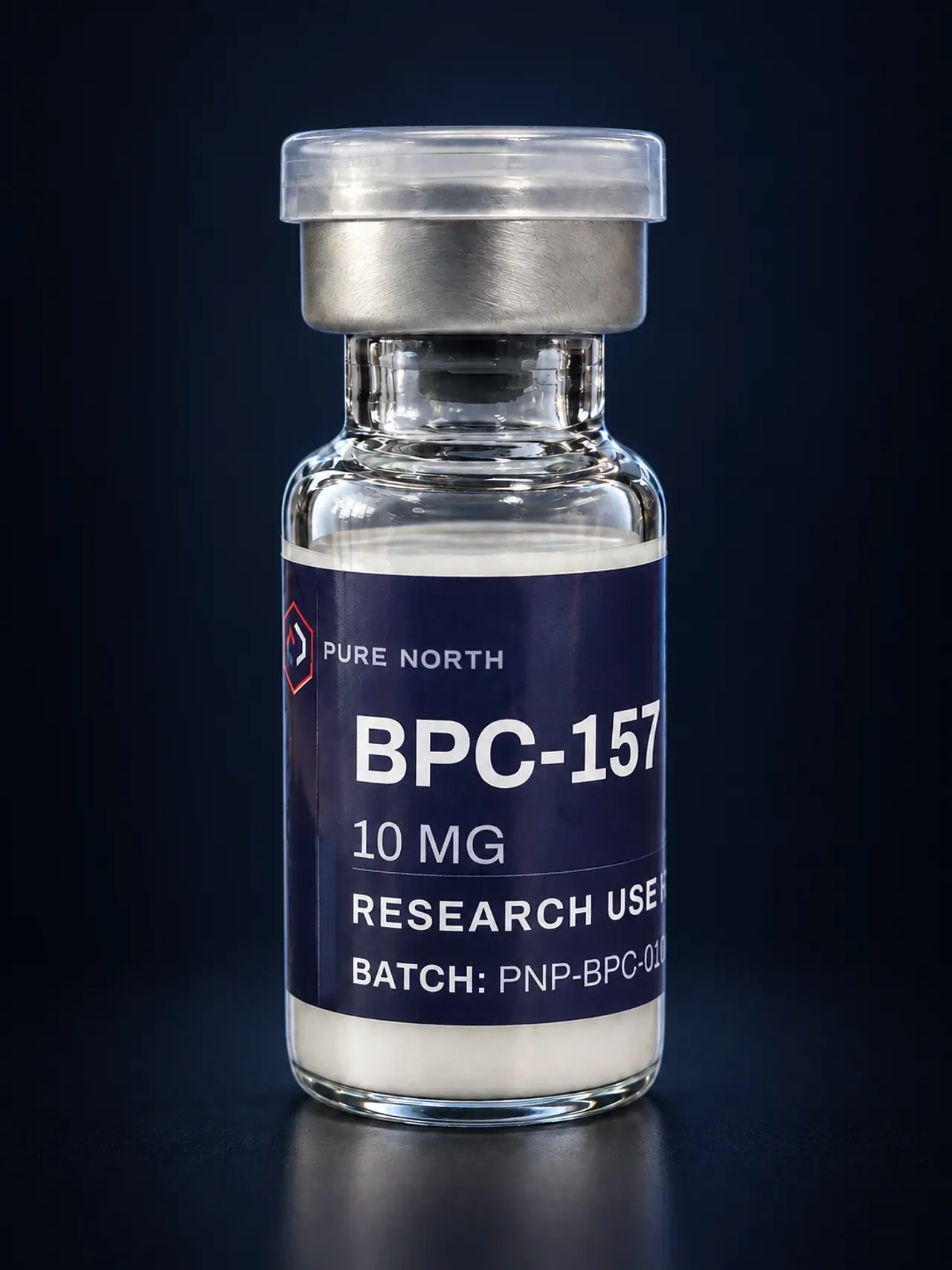

BPC-157
10 mg
$75 CAD$7.04/mg
View sample COA · 10 mg
99.71% area purity · 10.65 mg measured content
Assigned reference: PNP-BPC-1002 · Report CPT-BPC-10-091226
The report uses an assigned reference; it differs from the photographed vial code.
In stock10 mg per vial
1
How payment works: submit your order, then follow the Interac e-Transfer or Bitcoin instructions shown on the confirmation screen. Orders ship after payment is confirmed. Shipping is $30 CAD, free once your subtotal reaches $300 before any discount.
$75 CAD
Healing - Pentadecapeptide →
A 15-residue Body Protection Compound, one of the most-studied peptides in the repair space. Read the published report for the named 10 mg sample.
Independent lab result
Canada Peptide Testing ↗BPC-157 · 10 mg vial
Assigned reference: PNP-BPC-1002
Purity
99.71%
Measured
10.65 mg
Label claim
10 mg
Fill accuracy
106.5%at or over label
Method
RP-HPLC-UV, 214 nm
Specification
≥ 98.0% area purity
Tested
2026-09-09
Reported
2026-09-12
Report CPT-BPC-10-091226. Results apply to the sample tested. Purity is area purity by RP-HPLC-UV, 214 nm; these certificates carry no endotoxin or mass-spectrometry result. All certificates →
For laboratory research use only. Handling & research protocol →
Free shipping over $300, flat $30 underDispatched in 24–48h by Canada Post XpresspostTracked on dispatch, discreet outer packagingBest price in Canada — found it cheaper? we'll match it →
Research overview
BPC-157 and TB-500: a research overview
Read →
Research overview
How to read a peptide certificate of analysis
Read →
Research overview
How to evaluate a research peptide supplier in Canada
Read →
BPC-157 Canada buyer guide
Read guide →
BPC-157 reconstitution protocol
Read guide →
BPC-157 vs TB-500
Read guide →
BPC-157 on PubMed
Independent published literature indexed on PubMed (U.S. National Library of Medicine). Provided for laboratory research reference only.
- PMID 30915550Gastric pentadecapeptide body protection compound BPC 157 and its role in accelerating musculoskeletal soft tissue healingCell Tissue Res · 2019 · PubMed →
- PMID 40005999Multifunctionality and Possible Medical Application of the BPC 157 Peptide — Literature and Patent ReviewPharmaceuticals (Basel) · 2025 · PubMed →
- PMID 40756949Emerging Use of BPC-157 in Orthopaedic Sports Medicine: A Systematic ReviewHSS J · 2025 · PubMed →
BPC-157 questions
Does the BPC-157 assigned reference have to match my vial label?
Match the compound, vial size and printed lot to the report before relying on it. An assigned reference is not automatically the batch code on a vial. If they differ, email purenorthpeptides@proton.me with the vial details and report number to confirm the connection. Do not extend a report to another size or lot.
How do the reported purity and measured content compare?
CPT-BPC-10-091226 reports 99.71% RP-HPLC-UV area purity and 10.65 mg measured content for its 10 mg vial. Area purity is a chromatographic response percentage, not a percentage of the label mass. Read both results in the original document.
What certificate is published for BPC-157?
Yes. The independent certificate for the 10 mg vial, report CPT-BPC-10-091226, is published on this page and in Lab Results. It covers the sample and size named on the report. For another size or lot, contact purenorthpeptides@proton.me.
How is BPC-157 shipped?
Orders ship from Canada by Canada Post Xpresspost. Delivery is usually about four days, with free shipping once the pre-discount subtotal reaches $300 CAD.
How do I pay?
Submit the order online, then follow the Interac e-Transfer or Bitcoin instructions on the confirmation screen. No card details are entered anywhere on the site.
Where is the reported BPC-157 dosage and reconstitution information?
The BPC-157 protocol page reproduces the schedule, route and cycle length reported in published research, and computes a reconstitution concentration table for the 10 mg vial we ship. It is reference information for laboratory research, not a recommendation. The peptide calculator does the syringe-unit arithmetic for any solvent volume.
No reviews for BPC-157 yet. Reviews here can only be written by someone who bought the product, using a single-use link emailed after the order ships, and each one is approved by a person before it appears. Only genuine, approved buyer feedback appears here.
How reviews work here →Products from the same research category, plus compatible laboratory diluent where applicable.


